In the spotlight for review today is the long awaited, Limited Edition, Fountain Pen Network - Stipula Passporto!
This brand new (and already sold out) pen has been long in the making, and has been extremely anticipated for the last few months.
Being a special production pen from Stipula Italy, made just for the Fountain Pen Network, I have high expectations. We'll see how this pen does! Read on for the overview:
Current Most Popular Post
-
Here's a deal you don't want to miss out on! I'm going to be giving away a free fountain pen . But not just any pen... This pen...
Showing posts with label Pen Review. Show all posts
Wednesday, January 18, 2012
Friday, November 25, 2011
Review: Lamy 2000
Time for another pen review!
Up for review today is the highly acclaimed Lamy 2000.
As with all my reviews, I try to be subjective, and honest. Even though this is on my top 5 pens list, I still have some issues with it that we'll hit on this article.
Up for review today is the highly acclaimed Lamy 2000.
As with all my reviews, I try to be subjective, and honest. Even though this is on my top 5 pens list, I still have some issues with it that we'll hit on this article.
Overview:
- Really cool, award winning design
- Intelligent functionality
- Excellent ink capacity
- Extremely durable - a true survivor
The bad:
- Cap "nubs" can be very annoying to some users
- The design is either "you hate it or you love it"
- Piston can tend to be a bit stiff
- Prices have gone up recently
The Lamy 2000 is a pen that has been, and will continue to be at the top of my collection. Though recently pared down to only two pens, the Lamy 2000 remained in my fountain pen collection. Being a very picky FP user, that is saying something!
I highly recommend this pen to anyone who is looking for a solid/reliable pen to take with them everywhere. This is one that you can clip into your pants pocket, and not worry about it. It takes a beating, and it doesn't even show. The matte finish texture seems practically invincible, and it looks great too.
If you're in the market for a new pen, I see no reason that you should hesitate to purchase the Lamy 2000!
Read on for the full review:
If you're in the market for a new pen, I see no reason that you should hesitate to purchase the Lamy 2000!
Read on for the full review:
Saturday, November 5, 2011
Pen review - Pilot Vanishing Point!
Yes! Time for another pen review! I love reviewing pens... :)
The star of today's review is the Pilot Vanishing Point. If you've been into fountain pens for even a short amount of time, you will probably recognize this name. This is a VERY popular pen, and for good reason!
The Pilot Vanishing Point is all about convenience, and ease of use. It's not marketed as a luxury pen, or a pen made for looks. It's marketed instead, as a pen that is built with the user in mind. It is designed around the task of writing on the go.
As we dive into this review, we'll hit on 5 categories. Each one will be scored on in two ways, on a scale of 1/100. It will be scored on both: 1) How it stacks up against pens in the same price range. And 2) How it compares to perfection. The reason for these rankings is to show how good the pen is, and how good it could be. There is no such thing as a perfect pen, and compared to perfection, even the best pens can fall short. Still this scoring method shows what could be improved upon the design, and points out things that you might not like about it. The method of ranking the pen against similar pens in it's price-range helps to identify what you get for your money, and shows off the good features of the pen. I hope that makes sense. Keep reading, and it will make even more sense as the review goes on.
The star of today's review is the Pilot Vanishing Point. If you've been into fountain pens for even a short amount of time, you will probably recognize this name. This is a VERY popular pen, and for good reason!
The Pilot Vanishing Point is all about convenience, and ease of use. It's not marketed as a luxury pen, or a pen made for looks. It's marketed instead, as a pen that is built with the user in mind. It is designed around the task of writing on the go.
As we dive into this review, we'll hit on 5 categories. Each one will be scored on in two ways, on a scale of 1/100. It will be scored on both: 1) How it stacks up against pens in the same price range. And 2) How it compares to perfection. The reason for these rankings is to show how good the pen is, and how good it could be. There is no such thing as a perfect pen, and compared to perfection, even the best pens can fall short. Still this scoring method shows what could be improved upon the design, and points out things that you might not like about it. The method of ranking the pen against similar pens in it's price-range helps to identify what you get for your money, and shows off the good features of the pen. I hope that makes sense. Keep reading, and it will make even more sense as the review goes on.
Thursday, August 18, 2011
The ultimate TWSBI review! Part 6!
Well, this is the last part of my ultimate TWSBI review. Half of this part is going to be an in-depth re-cap of previous parts. The rest of it will finally conclude this mega-review. Once part 6 is done, it'll be time to move on and start reviewing other stuff! :)
As I will continue to do - Here's a quick re-cap with links to the 5 previous parts of the review:
Thursday, July 14, 2011
The ultimate TWSBI review! Part 5!
We're starting to wrap things up here. Part 5 is pretty much the last important part of the review. Not that part 6 will be unimportant. It just won't be as much so. I don't have as many pictures for this part of the review. What I do have (and why it took me so long to do part 5) are two full video tutorials for you!
As I will continue to do - Here's a re-cap of the 4 previous parts of the review:
Recap of Part 1:
As I will continue to do - Here's a re-cap of the 4 previous parts of the review:
Recap of Part 1:
- How did the TWSBI come about?
- What is the TWSBI is all about?
- What exactly is the TWSBI Diamond 530?
- Packaging
- Presentation
- Appearance and design
Recap of Part 4:
- The nib
- How does it write?
- Writing samples
Today's part of the review is:
Part 5:
- Filling mechanism
- Mechanics/functionality
I'll waste no time in moving right in. :)
The TWSBI, in my opinion, is once again the best functioning pen ever made for under $100.00. It utilizes a piston filling mechanism almost identical to those found in the Pelikan M800 and M1000. Since getting my TWSBI I have become a piston filler addict! I love how they work, especially in a demonstrator. For me, a piston filler is basically ideal, but I thought I'd give a pros/cons type of thing on it anyway. I'm going to compare it to the most common type of filler in this price range ($100.00 and below): a cartridge/converter (AKA c/c filler).
Pros of a piston filler:
- Holds a huge amount of ink. Especially if you're used to c/c fillers.
- In the case of the TWSBI - It is fully serviceable by the user! No need to send your TWSBI off for routine maintenance. :)
- Again in the case of the TWSBI (a demonstrator pen) - The piston filler is a lot more fun/cool then a c/c filler.
- Can be cleaned extremely easily and quickly. This is a huge bonus for me.
Pros of a c/c filler:
- Easy and cheap to replace.
- You can change inks more often in them as they run out quickly. This is not a plus for me but it is for some...
Cons of a piston filler:
- If you like to change ink often, you may not like the large capacity.
- If the mechanism were to break, it would be more expensive to buy a replacement piston than a c/c filler. Then again, it's a lot less likely to break than a c/c filler.
Cons of a c/c filler:
- They will eventually fail and need to be replaced. Usually much sooner than a piston.
- They do not provide as much fun/enjoyment as a piston filling system does. To me, c/c fillers are a bit boring...
- They hold (especially some like the pilot VP varieties) very little ink. This means that you'll be filling more often and getting inky more often. For most users this is a downfall. Don't get me wrong, there are some big converters, but most that you'll get in a $150.00 and below pen are the small kind.
That's all I can really think of. For me, the good of a piston filler far outweighs the bad. I personally have a distaste for c/c fillers. I've never liked them and never will. This is why the TWSBI was such a welcome pen in my "flock". A pen for under $100.00 that's not a c/c filler!?!? TWSBI got it right on this one! Some pictures of the piston mechanism just for fun:
Now, another huge feature of a piston filler, specifically on the TWSBI, is the ability for the average user to service it without assistance. The TWSBI comes with all the necessary tools to take apart, and perform routine maintenance on the piston. This feature completely won me over to this pen.
One small problem however, is that there is some slight confusion on how to take apart he piston. There is in fact, a right and wrong way to re-assemble the piston. I decided to make an entire video for this part of the review (Actually two videos. See the part on filling.). I hope it will solve any problems you might encounter while re-assembling your piston!
I think that's about it for the filling system. I'll give it again a solid 100/100 for its price range. For what a filler could be, I'll still say 80/100. This version of the piston (the 530 version) is not perfect. Apparently if you're rough on it, you'll experience leaking. I've never heard of a case of this but speedy says it's true so I'll trust that. Also, I prefer a brass piston mechanism (like the Pelikan M800). It adds some nice weight to the pen and has a longer lifespan. Still, I don't think you'll ever have any problems with the TWSBI piston. Plus, I'm certain that if it ever failed, TWSBI would replace it free of charge. Overall, I love this pen's filling system. Even more so than ever, I really dislike c/c fillers. I've rid my collection of all of them... Did I forget to tell you that I love piston fillers. ;)
Now on to:
This will cover all of the little details of the pen. Things like: how the cap screws on, what's the clip like, how tight is the piston, how do the nibs unscrew, etc. I'm going to inevitable miss some stuff so bear with me. I will do my best though!
First thing I want to do is show how to fill the pen. This is the second video I made for this review. This is why it took me so long to make part 5. Two videos!
Now I'll talk on some specific details, and in no particular order...
The clip: I think the clip on this pen is great. It's a bit tight but certainly not to much so. It a steel folded construction though it will be solid brass in future versions of the pen. I do wish it had a little less play side-to-side. It's not much at all but I wish there was none. Also, I'm a fan of spring loaded clips like vintage Sheaffers or some modern Watermans. Overall though, an excellent clip.
The cap: A pretty decent cap if I do say so myself. :) It takes exactly 2 full revolutions to remove or replace the cap. This a bit much but it's most certainly not unbearable. Near the end of the last turn it really tightens down with a rubber-gasket type of feel. I hope that makes sense... :) Some really dislike this as they use the clip to open/close the cap. They fear it will pop the clip right off. I do not fear this for two reasons: 1 - the clip is stronger than that. 2 - I don't sue the clip as leverage to close/open the cap. I like the firm closing as it really seals it against ink spills. If ink ever did leak out, it wouldn't leave the cap, that's for certain. Again overall, a very nice cap.
Piston function: The piston functions very well. I can't say completely flawless but near perfect. No problems even worth reporting. I have found it get's tight, not stiff, but tight after a while. It's not the piston gasket that causes this but the piston knob. Some silicone grease would do the job. An easy fix thanks to the included TWSBI wrench and silicone grease bottle.
The changeable nib units: An excellent touch for this pen. I love em'. I have a M nib that I ground to a stub and a B nib that I ground to a CI. Both lovely and I can now change them anytime with great ease. It's very nice to be able to swap nibs so easily on this pen. I've already talked about the nib in Part 4, so go back there for more detail on that.
The gripping section: Again, not to much to note here. Comfortable to me. Thinner than my Pelikan M800 but not too thin. Some people think it's big. I call it medium sized. It slightly flares out near the nib to prevent your fingers from slipping on to the nib. I like this feature. Pens that don't have this always leave me with inky fingers... :)
I can't think of any more little details for now. If I do, I'll add them on later. Let me know if I missed something vital. As far as ranking goes: probably 90/100 for a pen of its price range. There are some other pens withing this price range with a few better features. They also have many worse features. For what a pen could be: probably 70/100. It has faults, but I've never had a problem with any of them. Overall I love the function/mechanics of this pen and wouldn't change much even if I had the opportunity to.
That really sums up this part of the ultimate TWSBI review. I hope that once again you've enjoyed this thoroughly. It's been challenging but we're almost done now. Just one more part to do after this one! Please leave me a comment and tell me what you're thinking. I really want to hear! Did I miss something? Did you love it? Hate it? Do tell, I'd be more than happy to answer questions too. You can always send me an email anytime.
Keep your eyes open for part 6 of the review! Subscribe today so you don't miss out!
Part 6:
Piston fillers are just really cool looking. Especially in a demonstrator.
You can see the piston head, the piston rod, and all the other cool parts up at the top. To me, having a lever filling a c/c filling demonstrator is sort of a waste. I tihnk demonstrator should be reserved for interesting filling systems such as: pistons, vacumatics, lever-fillers, and button fillers. I think those pens have enough of an interesting mechanism to deserve a demo body. Also, all of those fillers, if you'll notice, have the filling system incorporated into the body of the pen.
Here's the piston nob with the piston rod coming out into the knob chamber.
Overall, piston fillers are cool, fun, interesting, and work extremely well too!
Now, another huge feature of a piston filler, specifically on the TWSBI, is the ability for the average user to service it without assistance. The TWSBI comes with all the necessary tools to take apart, and perform routine maintenance on the piston. This feature completely won me over to this pen.
One small problem however, is that there is some slight confusion on how to take apart he piston. There is in fact, a right and wrong way to re-assemble the piston. I decided to make an entire video for this part of the review (Actually two videos. See the part on filling.). I hope it will solve any problems you might encounter while re-assembling your piston!
I think that's about it for the filling system. I'll give it again a solid 100/100 for its price range. For what a filler could be, I'll still say 80/100. This version of the piston (the 530 version) is not perfect. Apparently if you're rough on it, you'll experience leaking. I've never heard of a case of this but speedy says it's true so I'll trust that. Also, I prefer a brass piston mechanism (like the Pelikan M800). It adds some nice weight to the pen and has a longer lifespan. Still, I don't think you'll ever have any problems with the TWSBI piston. Plus, I'm certain that if it ever failed, TWSBI would replace it free of charge. Overall, I love this pen's filling system. Even more so than ever, I really dislike c/c fillers. I've rid my collection of all of them... Did I forget to tell you that I love piston fillers. ;)
Now on to:
mechanics/function
This will cover all of the little details of the pen. Things like: how the cap screws on, what's the clip like, how tight is the piston, how do the nibs unscrew, etc. I'm going to inevitable miss some stuff so bear with me. I will do my best though!
First thing I want to do is show how to fill the pen. This is the second video I made for this review. This is why it took me so long to make part 5. Two videos!
Now I'll talk on some specific details, and in no particular order...
The clip: I think the clip on this pen is great. It's a bit tight but certainly not to much so. It a steel folded construction though it will be solid brass in future versions of the pen. I do wish it had a little less play side-to-side. It's not much at all but I wish there was none. Also, I'm a fan of spring loaded clips like vintage Sheaffers or some modern Watermans. Overall though, an excellent clip.
The cap: A pretty decent cap if I do say so myself. :) It takes exactly 2 full revolutions to remove or replace the cap. This a bit much but it's most certainly not unbearable. Near the end of the last turn it really tightens down with a rubber-gasket type of feel. I hope that makes sense... :) Some really dislike this as they use the clip to open/close the cap. They fear it will pop the clip right off. I do not fear this for two reasons: 1 - the clip is stronger than that. 2 - I don't sue the clip as leverage to close/open the cap. I like the firm closing as it really seals it against ink spills. If ink ever did leak out, it wouldn't leave the cap, that's for certain. Again overall, a very nice cap.
Piston function: The piston functions very well. I can't say completely flawless but near perfect. No problems even worth reporting. I have found it get's tight, not stiff, but tight after a while. It's not the piston gasket that causes this but the piston knob. Some silicone grease would do the job. An easy fix thanks to the included TWSBI wrench and silicone grease bottle.
The changeable nib units: An excellent touch for this pen. I love em'. I have a M nib that I ground to a stub and a B nib that I ground to a CI. Both lovely and I can now change them anytime with great ease. It's very nice to be able to swap nibs so easily on this pen. I've already talked about the nib in Part 4, so go back there for more detail on that.
The gripping section: Again, not to much to note here. Comfortable to me. Thinner than my Pelikan M800 but not too thin. Some people think it's big. I call it medium sized. It slightly flares out near the nib to prevent your fingers from slipping on to the nib. I like this feature. Pens that don't have this always leave me with inky fingers... :)
I can't think of any more little details for now. If I do, I'll add them on later. Let me know if I missed something vital. As far as ranking goes: probably 90/100 for a pen of its price range. There are some other pens withing this price range with a few better features. They also have many worse features. For what a pen could be: probably 70/100. It has faults, but I've never had a problem with any of them. Overall I love the function/mechanics of this pen and wouldn't change much even if I had the opportunity to.
That really sums up this part of the ultimate TWSBI review. I hope that once again you've enjoyed this thoroughly. It's been challenging but we're almost done now. Just one more part to do after this one! Please leave me a comment and tell me what you're thinking. I really want to hear! Did I miss something? Did you love it? Hate it? Do tell, I'd be more than happy to answer questions too. You can always send me an email anytime.
Keep your eyes open for part 6 of the review! Subscribe today so you don't miss out!
Part 6:
- Overview/re-cap of previous parts
- A conclusion/thoughts on the TWSBI Diamond 530
Keep watch for that last part. It's not going to be as picture heavy as previous parts but it will be just as important. Again, subscribing will keep you informed on when the next part comes out and all of the other cool new things coming up soon.
Regards,
777 - Tyler Dahl
Monday, July 4, 2011
The ultimate TWSBI review! Part 4!
Make sure you don't forget about the free give-away going on! Check it out here for a chance to win!
Well, we've made it to part 4 of the ultimate TWSBI review. So far this has been a fun, exciting, and informative challenge for me to write! Today's part is going to cover the most important aspect of a fountain pen. I hope you'll enjoy this as much as I have enjoyed putting it together. Be sure to subscribe so you'll know when the next part is coming out!
For those who may have forgotten, here's a quick recap with links to the other 3 parts. Make sure to go back and look at these if you haven't. There's a lot of essential information in them.
Recap of Part 1:
- How did the TWSBI come about?
- What is the TWSBI is all about?
- What exactly is the TWSBI Diamond 530?
- Appearance and design
Part 3 of the review is, to me, the second most important part of a fountain pen. The single, most important part of any fountain pen is:
Monday, June 27, 2011
The ultimate TWSBI review! Part 3!
Make sure you don't forget about the free give-away going on! Check it out here for a chance to win!
Alright, we're now into the 3rd part of my ultimate TWSBI review. This multi-part, extensive, and detailed review has (and still is) taken me along time to put together. I'm working on it as I go, posting each part as I finish it. Make sure to subscribe to get notified of when the next apart comes out.
For those who are late in veiwing this review, here's a quick recap with links to the other 2 parts. Make sure to go back and look at these if you haven't. There's a lot of essential information in them.
Recap of Part 1:
- How did the TWSBI come about?
- What is the TWSBI is all about?
- What exactly is the TWSBI Diamond 530?
Recap of Part 2:
- Packaging
- Presentation
In part 3 of this extensive review we will be discussing what is (to me at least) the second most important aspect of a pen. Aside from nib performance, design is everything. This is exactly what this entire part is going to be devoted to.
Wednesday, June 22, 2011
The ultimate TWSBI review! Part 2!
Make sure you don't forget about the free give-away going on! Check it out here for a chance to win!
Today we're going to move on to part 2 of my ultimate TWSBI review! If you missed out on Part 1, go back and read it right now. It will help you better understand this part (#2) and all the other parts of this review.
For a quick recap I'll show what was reviewed in part 1.
Recap of Part 1:
- How did the TWSBI come about?
- What is the TWSBI all about?
- What exactly is the TWSBI Diamond 530?
Now we can move on to part 2 of the ultimate TWSBI review. In this part we'll be discussing some important elements of the pen design.. Some will be more interested in other aspects of the review but to me, looks are almost everything when it comes to buying a new pen. This applies even to the smallest details.
Part 2:
- Packaging
- Presentation
As we dive into this, again keep in mind that I'll be ranking each aspect of the pen in two ways.
- What the pen is in comparison to others in its price range
- What the pen could be
Saturday, June 18, 2011
The ultimate TWSBI review! Part 1!
This is going to be a super-sized review of a pen that's caused a lot of excitement in the fountain pen community. This review is promising to be extremely long, so I will be posting it in separate parts -- probably around five -- as I go. I hope you will enjoy this review as much as I'm enjoying putting it together for you!
Also, make note of my method for ranking this pen. I will consider each aspect of the pen from two different angles. It will be given a rating for both:
- What the pen is, in comparison to others in its price range
- What the pen could be
The reason for these classification is to ensure that the review is accurate. By comparing the pen to others in its price range, you'll be able to see what incredible value this pen has to offer. By comparing the pen to what it could be, you'll get my honest opinion on what could be improved about the design.
That being said, let's move right in and get started!
Wednesday, June 15, 2011
My grail pen has finally arrived! Lovely Pelikan M805 Blue Stripe!
I've wanted one of these for a very long time now. The Pelikan Souveran range always caught my eye as a series of beautiful, reliable, and reasonably priced pens. By reasonably priced I mean the approx. $300.00 they cost goes mostly towards quality. Many other pens of this price range waste the said amount on fancy gold trims or engravings in the pen.It took me forever to decide which size to get. The only real way to get the exact right size was to try them out. Lucky for me, I had an extremely generous friend who loaned me an M400, M600, M800 and M1000 for test-driving.
Sunday, June 12, 2011
TWSBI Diamond 530! I finally got one!
I don't excite too easily, and when I do I'm usually still pretty calm, but this is one pen I am ecstatic about! I am totally, 100%, all the way loving this pen to the fullest! It quite simply is the best pen on earth for under $40.00 (what is costs brand new). I'd venture to say the best for under $100.00 even!
This said pen is my new TWSBI Diamond 530. It's a piston filler demonstrator (for $40.00!) that is of exceptional quality for the price. I won't delve into the story of its creation, it's a very long one. I will say that this is a pen made for the FP enthusiast!
Monday, May 30, 2011
Pelikan size comparison
Recently a good friend of mine was so generous as to loan me some of his gorgeous pens to "test-drive". I was thinking of reviewing them but there are already so many reviews out there so I thought I'd do something a little different. I decided to do a quick little size comparison showing the difference between the (seemingly) most popular Pelikan models. The Pelikans featured here are the m400, m600, and m800. Accompanying them is a beautiful Sailor 1911 and my Parker 51.
Saturday, May 14, 2011
Parker 51 VS. Hero 616 Jumbo. An extensive comparison...
So, here is going to be a comparison of two pens. Some people say these pens cannot be compared because of the huge price difference. I'm not of that opinion. I like both of these pens and they are very, very similar. Being so similar I thought I'd do a head on comparison and really nail down the differences and similarities between them.
Here goes:
Note: Remember to just click on the pictures for a super-sized view of them!
Parker 51 VS. Hero 616 Jumbo.
I'll start out by talking just a bit about each pen.
Paker 51 - This pen has become legend among collectors as "the best pen in the world". Now, in some respects it certainly is not the best pen in the world. When people say that they refer to the fact that the Parker 51 is such a timeless and well built pen. It lasts, it's extremely sturdy, it still looks modern even though the design is over 50 years old. Most of all it's one of the most reliable pens ever made. Specifically the Aerometric model which I'll be using in the review. The Vac-Fills are also great but the Aeros are prctically indestructible.
Hero 616 Jumbo - This pen is, in the simplest sense, a Chinese knock-off of a real Parker 51. However, this pen does sport some good qualities which the 51 does not. As a pen it's very actually nice and when compared to a real 51 it can hold its own...
**********************************************************************************
So, lets jump right in with size, weight, dimensions, etc.
Parker 51 - 5 1/2" or 14cm capped - 5" or 12.7cm uncapped - 6 15/16" or 15.1cm posted - 2 1/2" or 6.3cm cap length
Hero 616 - 5 9/16" or 14.2cm capped - 5 1/16" or 12.9cm uncapped - 5 7/8" or 14.9cm posted - 2 9/16" or 6.5cm cap length
I don't have a scale on hand but the 51 weighs almost twice as much as the 616. See the materials section for more information on this...
So, both pens are very close in dimensions the 616 being a tiny bit larger. Both pens are a very good size for me and feel comfortable in hand. One thing you will notice in the pictures below is that the 616's hood is much longer than the 51's. The 51 has a longer barrel, shorter hood. The 616 has a shorter barrel, longer hood. Measurments as follows:
51 - 1 1/2" or 4cm hood length - 3 3/8" or 8.6cm barrel length
616 - 1 7/8" or 4.7cm hood length - 3 1/8" or 7.8cm barrel length
**********************************************************************************
Appearance and Design
Both pens look good though in my opinion the 51 is definitely a better looing pen. Especially if ou get one with a GF cap. To be fair to the 616 decided to use a simpler 51, just black with a steel cap.
Both pens are simple, understated and somewhat modern looking. At a distance, they can easily be mistaken for a ballpoint. Sometimes thi sis nice and other times not so much. If you're trying to not get noticed by carying a fountain pen tan a 51 or 616 is a good choice. If you want people to see that gorgeous open nib then a 51 or 616 is notyour best bet. I like the hooded design, others hate it. Many people grow to like it because they like the way the pen works so much.
**********************************************************************************
Materials or Fit & Finish
Here I'll talk about the materials used in each pen. 51's differ from pen to pen in things such as cap material i.e. - gold, lustraloy, steel, etc.
Parker 51 - This pen has much beter materials than those of the 616. The plastic is thick and durable, the cap s much thicker too. Caps are usually steel, lustraloy, or gold filled. All of these are built very well and last for a very long time. The thicker plastic and steel cap make the 51 much heavier than the 616. The 51 is considered to be a light pen on its own...
Here 616 - This pen on the other hand has very inferior plastic. That's not to say it doesn't get the job done. On its own it stands very well but whe ncompared with a real 51 it is lakcing. The cap is really what's lacking. It's machined aluminum and is very lgihtweight. I can forsee the 616's cap getting dinged up very easily due to how thin it is. Because of the thin plastic and aluminum cap the 616 is a very lightweight pen.
Fit & Finish gets me talking of quality control aspects for each design. The Parker is by far a superior made pen. I'll talk a little more aobut this in the materials section but here I'll talk about the QC of the 51 VS. 616.
From afar both pens look very nice but it's only when one examines them up close that one begins to really notice the flaws i nthe 616's design. Things like: cheaply stamped clips, offset/crooked jewels, sharp edges on metal pieces, machining marks, unfinished pieces, etc. These are the kind of problems the 616 has. The 51 has none of these. It is superbly finshed and made in every aspect.
**********************************************************************************
Filling System
Both pens use the same filling system the 616 being a copy of the 51. For a cheap pen the 616 has a very nice filling system. It functions just as well as my 51's filling system. The only gripe I have with the 616's filler is the sharp edges we talked about in quality control.
Parker 51 - We are spekaing of Aerometric fillers today as I don't think the 616 is comparable to a Vac 51. The 51 uses a very well designed Aerometric filling system. This system was design over 50 years ago and still is one of the best out there. It is said to be leak proof in flight which my 51 certainly is. The 51 utilizes a plastic sac instead of a latex one. Though you can't see it in the pictures, the 51 sac is actually clear. Over the years it's been stianed black with ink but originally they were clear. The filler is operated by pressing the ribbed bar down 4 times while the pen point is in ink.
Hero 616 - Copying off of the 51's filling system makes this inexpensive pen have a very nice filling system for the price. The filler unit operation is the exact same on the 616 as it is on the 51. The filler is just a tad smaller in size. I havn't done a capacity test but someday I might. I also have not tested the 616 filling system in flight. I'm sure it would work just as well as the 51 though.
**********************************************************************************
Nibs
So, everything aside the most important hing about a pen is its nib. Mainly, the way it writes. I'll say right up front that both of tese pens are great writers. Both have ups and downs.
Parker 51 - First thing of not is it has a gold nib. Some people say gold nibs are better than steel. I've had no such experience. I enjoy my steel nib pens sometimes more than my gold nib ones. Still, gold is pretty to look at and is a status symbol of sorts. The 51 nib is what is known as a nail. Meaning it's a very hard nib with absolutely no flex at all. This is due to the tubular shape of it and te hood which prevents it from moving around. Now, in my case, the 51 has a uge advantage over the 616's nib. My 51 has a BB stub retip. I will not factor this in but instead talk about factory 51 nibs. The original fine nib I had on this pen was nice. Not great, not buttery smooth but nice. It wrote a fine line with 5/10 wetness aand it never complained. Parker nibs usually are good. I have yet to come across a bad one yet though I' msure they're out there.
Hero 616 - This pen can be both good or bad with the nibs. This is due to the lacing QC in the Chinese factories that produce these. If you have some knowledge of nib tweaking as I do then these 616's can be transformed into great writers! The fine nib on this 616 writes just as well as the factory nib on my 51 and it exhibits a softness to it instead of the nail hardness of the 51 nib. For the price these pens can be had for they are truly excellent writers. This nis is, just like the 51 nib, iridium tipped and will last for many years.
All in all both are great writers but the Hero wins out because of price.
**********************************************************************************
Pricing
Here's where the 616 really shines! in terms of value for dollar the 616 cannot be beat and totally smokes the 51.
Parker 51 pricing - This wuld be a fair price for a good condition pen, i.e. - not mint, but certainly not user grade. Nothing fancy like GF caps or rare colors. $85.00. 51 prices can go way up form thier but you can easily snag one for that price. Once you get into rare colors, DJ models, and factory stub nibs the price can up to $450.00 and beyond.
Hero 616 - This is where the pen tuly shines. They are best found on ebay in my experience and can be bought here in a 10 pack of 3 different colors (red, green, and black) for the humble price of $14.00 shipped. Now that's a deal! Only $1.40 a pen! They can be bought individually but they are about $4.00 a pen then. I would recommend getting a whole pack, keeping a few, and then giving the rest away as starter pens! These 616's are really a great value for dollar. Think about it, even if half the pens in the pack are bad you're still getting a great pen only $2.80 a piece! I've never heard of half a pack being bad. I have heard of having one or two duds in a pack of ten though...
**********************************************************************************
All in all these are both great pens and if I had to choose one I'd probably pick the 51. However, if you're wanting try out a real 51 but don't have the $$$ yet then buy a 616. They are excellent carry-around pens. I take mine places where I would never take my other pens...
Hope you'e enjoyed the review/comparison. Please, do me the huge favor of dropping a comment below. It helps keep me going on the blog!
Regards,
777 - Tyler Dahl
Here goes:
Note: Remember to just click on the pictures for a super-sized view of them!
Parker 51 VS. Hero 616 Jumbo.
I'll start out by talking just a bit about each pen.
Paker 51 - This pen has become legend among collectors as "the best pen in the world". Now, in some respects it certainly is not the best pen in the world. When people say that they refer to the fact that the Parker 51 is such a timeless and well built pen. It lasts, it's extremely sturdy, it still looks modern even though the design is over 50 years old. Most of all it's one of the most reliable pens ever made. Specifically the Aerometric model which I'll be using in the review. The Vac-Fills are also great but the Aeros are prctically indestructible.
Hero 616 Jumbo - This pen is, in the simplest sense, a Chinese knock-off of a real Parker 51. However, this pen does sport some good qualities which the 51 does not. As a pen it's very actually nice and when compared to a real 51 it can hold its own...
**********************************************************************************
So, lets jump right in with size, weight, dimensions, etc.
Parker 51 - 5 1/2" or 14cm capped - 5" or 12.7cm uncapped - 6 15/16" or 15.1cm posted - 2 1/2" or 6.3cm cap length
Hero 616 - 5 9/16" or 14.2cm capped - 5 1/16" or 12.9cm uncapped - 5 7/8" or 14.9cm posted - 2 9/16" or 6.5cm cap length
I don't have a scale on hand but the 51 weighs almost twice as much as the 616. See the materials section for more information on this...
So, both pens are very close in dimensions the 616 being a tiny bit larger. Both pens are a very good size for me and feel comfortable in hand. One thing you will notice in the pictures below is that the 616's hood is much longer than the 51's. The 51 has a longer barrel, shorter hood. The 616 has a shorter barrel, longer hood. Measurments as follows:
51 - 1 1/2" or 4cm hood length - 3 3/8" or 8.6cm barrel length
616 - 1 7/8" or 4.7cm hood length - 3 1/8" or 7.8cm barrel length
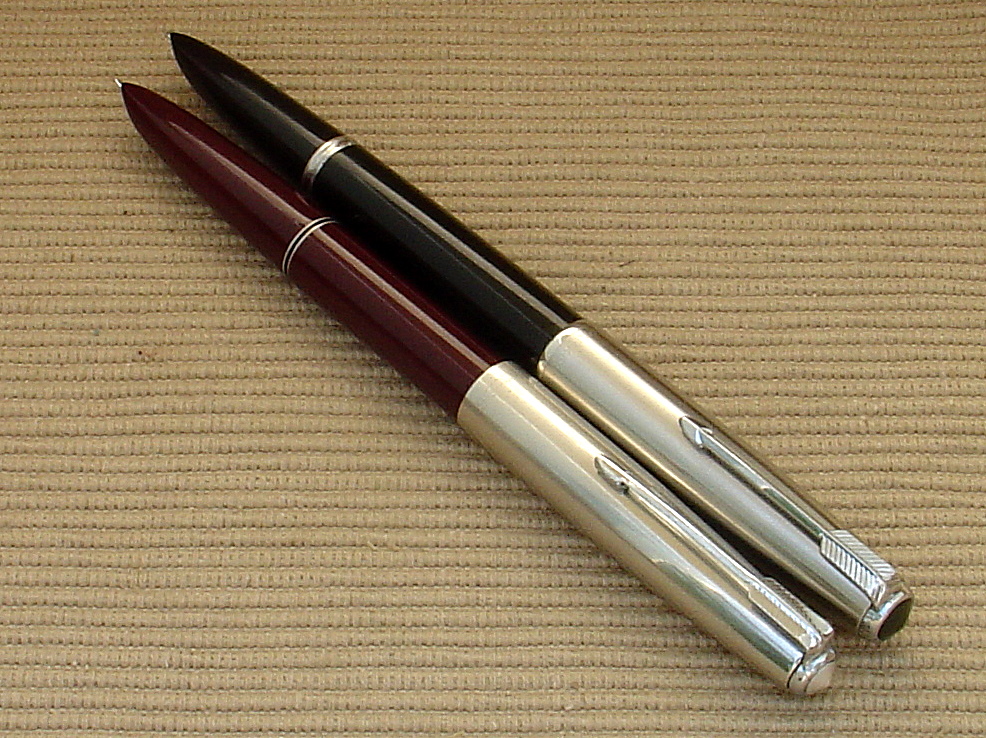
Here are both pens. The 616 is the red pen. The 51 is the black pen. keep that in mind throughout the review.
51's a bit longer posted...
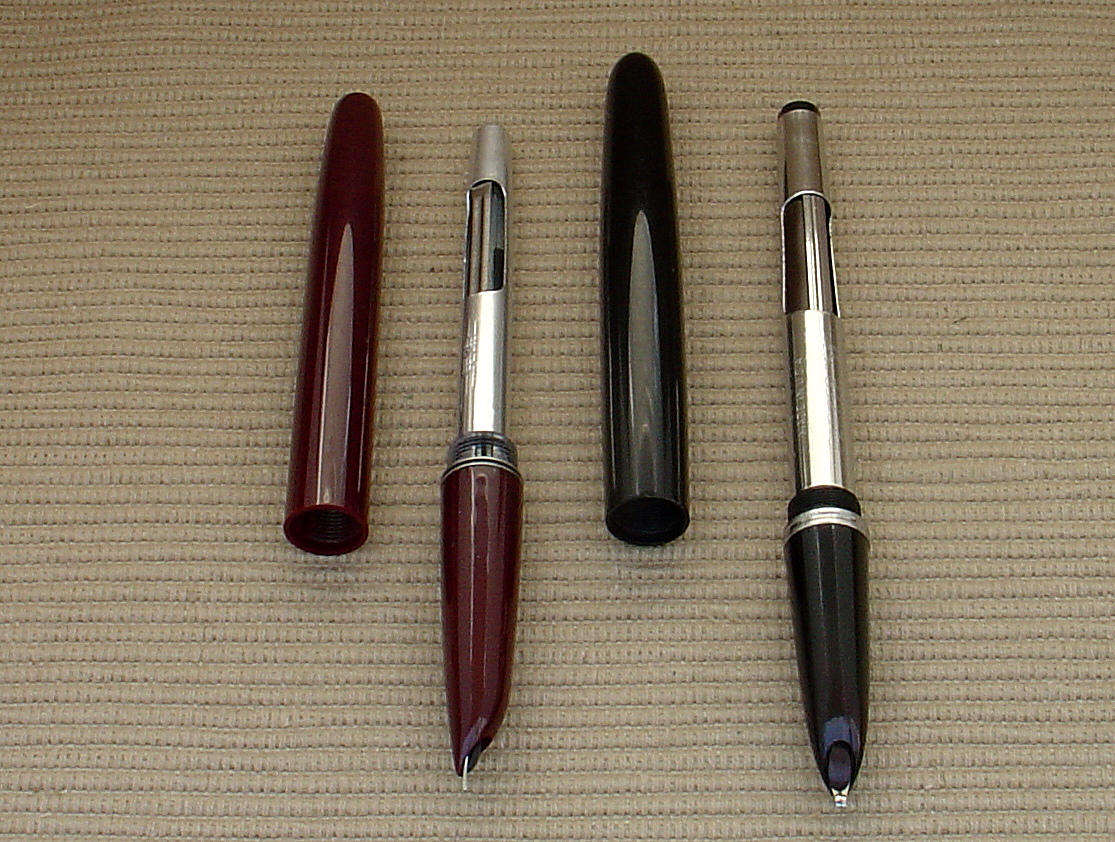
Notice the large section on the 616. Same length total but larger section. This makes the barrel smaller which makes the filler smaller too...
**********************************************************************************
Appearance and Design
Both pens look good though in my opinion the 51 is definitely a better looing pen. Especially if ou get one with a GF cap. To be fair to the 616 decided to use a simpler 51, just black with a steel cap.
Both pens are simple, understated and somewhat modern looking. At a distance, they can easily be mistaken for a ballpoint. Sometimes thi sis nice and other times not so much. If you're trying to not get noticed by carying a fountain pen tan a 51 or 616 is a good choice. If you want people to see that gorgeous open nib then a 51 or 616 is notyour best bet. I like the hooded design, others hate it. Many people grow to like it because they like the way the pen works so much.
Here are both pens, 616 in Red and Parker in Black. Very nice looking they are!
You can see the jewels in this picture. the 616 has a machined aluminum jewel as opposed to the 51's plastic jewel.
Here's a small design difference. The 616 has a very interesting clutch ring. It s transparent in between the two metal washers. The 51 clutch ring is all metal and a little thicker as you can see.
**********************************************************************************
Materials or Fit & Finish
Here I'll talk about the materials used in each pen. 51's differ from pen to pen in things such as cap material i.e. - gold, lustraloy, steel, etc.
Parker 51 - This pen has much beter materials than those of the 616. The plastic is thick and durable, the cap s much thicker too. Caps are usually steel, lustraloy, or gold filled. All of these are built very well and last for a very long time. The thicker plastic and steel cap make the 51 much heavier than the 616. The 51 is considered to be a light pen on its own...
Here 616 - This pen on the other hand has very inferior plastic. That's not to say it doesn't get the job done. On its own it stands very well but whe ncompared with a real 51 it is lakcing. The cap is really what's lacking. It's machined aluminum and is very lgihtweight. I can forsee the 616's cap getting dinged up very easily due to how thin it is. Because of the thin plastic and aluminum cap the 616 is a very lightweight pen.
Fit & Finish gets me talking of quality control aspects for each design. The Parker is by far a superior made pen. I'll talk a little more aobut this in the materials section but here I'll talk about the QC of the 51 VS. 616.
From afar both pens look very nice but it's only when one examines them up close that one begins to really notice the flaws i nthe 616's design. Things like: cheaply stamped clips, offset/crooked jewels, sharp edges on metal pieces, machining marks, unfinished pieces, etc. These are the kind of problems the 616 has. The 51 has none of these. It is superbly finshed and made in every aspect.
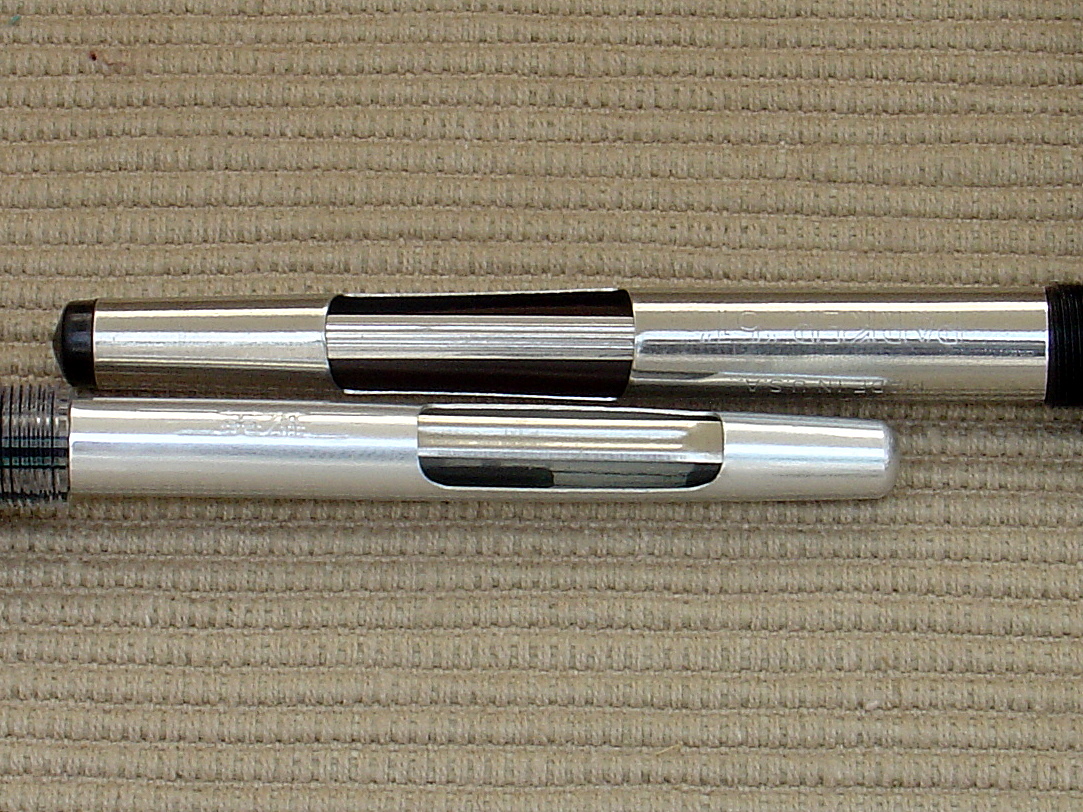
An example of the poor QC on the Hero. The 51 filler is on top and the 616 filler on the bottom. You can't really tell it in the picture but the edges of the opening in the 616's filler is very sharp and unfinished. Not very comfortable to press...
Here is another lack of QC in the 616. As you can see, the hole on the 616 (left pen) is rough and gouged from where the machine drilled it.
As can be seen here, the left cap, belonging to the 616, has a much sharper lip than the 51 cap (to the right).
**********************************************************************************
Filling System
Both pens use the same filling system the 616 being a copy of the 51. For a cheap pen the 616 has a very nice filling system. It functions just as well as my 51's filling system. The only gripe I have with the 616's filler is the sharp edges we talked about in quality control.
Parker 51 - We are spekaing of Aerometric fillers today as I don't think the 616 is comparable to a Vac 51. The 51 uses a very well designed Aerometric filling system. This system was design over 50 years ago and still is one of the best out there. It is said to be leak proof in flight which my 51 certainly is. The 51 utilizes a plastic sac instead of a latex one. Though you can't see it in the pictures, the 51 sac is actually clear. Over the years it's been stianed black with ink but originally they were clear. The filler is operated by pressing the ribbed bar down 4 times while the pen point is in ink.
Hero 616 - Copying off of the 51's filling system makes this inexpensive pen have a very nice filling system for the price. The filler unit operation is the exact same on the 616 as it is on the 51. The filler is just a tad smaller in size. I havn't done a capacity test but someday I might. I also have not tested the 616 filling system in flight. I'm sure it would work just as well as the 51 though.
Here are the Aerometric filling units of each pen. The 51's is definitely larger in size and capacity.
**********************************************************************************
Nibs
So, everything aside the most important hing about a pen is its nib. Mainly, the way it writes. I'll say right up front that both of tese pens are great writers. Both have ups and downs.
Parker 51 - First thing of not is it has a gold nib. Some people say gold nibs are better than steel. I've had no such experience. I enjoy my steel nib pens sometimes more than my gold nib ones. Still, gold is pretty to look at and is a status symbol of sorts. The 51 nib is what is known as a nail. Meaning it's a very hard nib with absolutely no flex at all. This is due to the tubular shape of it and te hood which prevents it from moving around. Now, in my case, the 51 has a uge advantage over the 616's nib. My 51 has a BB stub retip. I will not factor this in but instead talk about factory 51 nibs. The original fine nib I had on this pen was nice. Not great, not buttery smooth but nice. It wrote a fine line with 5/10 wetness aand it never complained. Parker nibs usually are good. I have yet to come across a bad one yet though I' msure they're out there.
Hero 616 - This pen can be both good or bad with the nibs. This is due to the lacing QC in the Chinese factories that produce these. If you have some knowledge of nib tweaking as I do then these 616's can be transformed into great writers! The fine nib on this 616 writes just as well as the factory nib on my 51 and it exhibits a softness to it instead of the nail hardness of the 51 nib. For the price these pens can be had for they are truly excellent writers. This nis is, just like the 51 nib, iridium tipped and will last for many years.
All in all both are great writers but the Hero wins out because of price.
Nibs of each pen. Both are excellent writer! Feed design is a little different on the 616 (right pen). Thinner and flatter than the 51 (left pen).
**********************************************************************************
Pricing
Here's where the 616 really shines! in terms of value for dollar the 616 cannot be beat and totally smokes the 51.
Parker 51 pricing - This wuld be a fair price for a good condition pen, i.e. - not mint, but certainly not user grade. Nothing fancy like GF caps or rare colors. $85.00. 51 prices can go way up form thier but you can easily snag one for that price. Once you get into rare colors, DJ models, and factory stub nibs the price can up to $450.00 and beyond.
Hero 616 - This is where the pen tuly shines. They are best found on ebay in my experience and can be bought here in a 10 pack of 3 different colors (red, green, and black) for the humble price of $14.00 shipped. Now that's a deal! Only $1.40 a pen! They can be bought individually but they are about $4.00 a pen then. I would recommend getting a whole pack, keeping a few, and then giving the rest away as starter pens! These 616's are really a great value for dollar. Think about it, even if half the pens in the pack are bad you're still getting a great pen only $2.80 a piece! I've never heard of half a pack being bad. I have heard of having one or two duds in a pack of ten though...
**********************************************************************************
All in all these are both great pens and if I had to choose one I'd probably pick the 51. However, if you're wanting try out a real 51 but don't have the $$$ yet then buy a 616. They are excellent carry-around pens. I take mine places where I would never take my other pens...
Hope you'e enjoyed the review/comparison. Please, do me the huge favor of dropping a comment below. It helps keep me going on the blog!
Regards,
777 - Tyler Dahl
Saturday, April 30, 2011
Review - Greg Minuskin Re-Tip to a Parker 51 nib!
Recently I've changed my tastes in what nib sizes I enjoy. I used to love my fine/extra fine nibs but these days I'm loving broad, 2B, and 3B stubs. The more ink output the better, right!?! Anyway, my Parker 51 had a very nice medium stub on it which I have enjoyed for quite some time. I loved that nib but after I tried my first broad stub - I never thought the same of that nib again... It was just a little to small for my new tastes.
Buying a new 2B stub for a Parker 51 is very expensive. I was quoted $130.00! Ouch is right... That's far to much for any nib. Along the road I heard about Greg Minuskin. He can re-tip your nib to any size (up to 1.8mm I think) for around $70.00! Not bad at all compared to $130.00! After exchanging a few emails back and forth, deciding on what size I wanted, and then selling the old nib to procure the funds, I was ready to get a re-tip. Let me just tell you this: Greg's work is amazing! The pictures will really tell the story so I'll leave the details to them. His turn-around time was way better than I expected. Less than two weeks! Just to show what he can really do, here are the before pictures of the nib. The tip on this nib was broken! This was (of course) no problem at all for Greg!
A bent nib with the left tine missing the tipping.
Here's another shot showing the bend and the broken tipping.
So, I sent my nib off in the mail to Greg who received it shortly thereafter. What I decided upon for my nib was a 1.3mm stub. This size is perfect for what I need though some people don't like nibs quite this large. After an appoximate 1.5 week wait I receiving it back in the mail, set it up in the pen, and tried it out, I'd say it's as good as a nib can get! Super smooth, excellent line variation, nice and wet! Greg was so pleasant to deal with and was very quick to respond to my questions. If I ever need another re-tip I know exactly who I'm going to.
Now for some pictures of the finished product! As always, just click on the picture for a super-sized view of it. I'll start with the photos that Greg sent me. They are much better than the ones I took, Greg is a great photographer!
There it is! Doesn't it just look gorgeous!
This nib looks good from both sides as Greg is very good at keeping things symmetrical.
Here's all of its 1.3mm of iridium goodness!
Underneath the nib. This is where all the magic happens!
A perfect 1.3mm! Nicely done Greg!
Here are the photos I took of both my pen and the nib compared to some other pens I had lying around. We have the Parker 51 with its 1.3mm stub, an Esterbrook with a 2284 Broad Stub, and a Hero 616 Jumbo with a fine nib.
Here's my favorite pen with my new favorite nib!
Uncapped it looks even better!
Here it is! Look at that 1.3mm tip sticking out! It looks awesome!
Here it is compared to the other pens. Hero 616 to the left - Esterbrook to the right.
Here you can really see the tipping sizes compared. Makes that fine nib in the Hero look so small!
Lastly, a hand-written sample of the nib compared with the other nibs. Greg really nailed down the line variation on this nib. This picture is certainly worth clicking on for a super sized view. You're gonna want to see this one big.
All in all I'm very pleased with my 1.3mm stub nib and the work Greg did for me. I have no doubts about his quality craftsmanship at all. I you ever need a re-tip please, give him a go, he will not disappoint you! His website is Greg Minuskin Nib Re-Tipping.
Please, drop me a comment below and let me know what you think of this review!
A big THANK YOU to Greg Minuskin for his awesome work!!!
Regards,
777 - Tyler Dahl
Sunday, April 10, 2011
Lamy Safari VS. Esterbrook J - A detailed side-by-side comparison!
The Esterbrook J always seemed to me a sort of vintage counterpart to the Lamy Safari. I believe both these pens can be put into the same category. They are entry-level pens that are very well made for what you can buy them for. I decided to do a head on review comparing the two of them - Their good points and bad points. Let's jump right in!
*********************************************************************************
First off: Pricing
These are both entry level pens that are priced for a beginner, someone on a tight budget, or anyone else who likes them.
Esterbrook J: Usually between $25.00 (beat up or maybe even un-restored) to $45.00 (In near perfect condition).
Lamy Safari: Runs almost the same. I got this one in the review for $25.00 but they can retail for $45.00.
*********************************************************************************
Secondly: Size and weight. I'll do the sizes both in mm and inches.
Lamy Safari: 14cm or 5 1/2" capped, 13cm or 5 1/4" uncapped.
Esterbrook J: 12.7cm or 5" capped, 11.7cm or 4 5/8" uncapped.
Here they are compared right next to each other. The Lamy Safari is longer by a good 1/2".
Here are the pens uncapped next to each other. The Lamy has a very noticeably larger section than the Esterbrook J.
Here's another cap and pen comparison.
As you can see, the Lamy is a bigger pen, but surprisingly it's not as heavy as the Esterbrook J. I don't have a scale currently but the Esterbrook J is definitely heavier than the Lamy Safari. Here are the pens in my hand. I have medium-ish sized hands.
*********************************************************************************
Next up: Nibs
In this area, both pens good advantages and disadvantages.
The Esterbrook has it's awesome trademark feature of interchangeable nibs. This is a huge bonus for any pen especially when extra nibs units can be found for $7.00 and up like the Estie nibs. The downfall of the Esterbrooks nibs is this: They really are hit or miss. I've had some horrible Esterbrook nibs before out of the box and other ones that are just perfect. They are not super dependable. Also, if you're not getting the iridium-tipped 9xxx series of nibs then their lifespan is shortened greatly. The 1xxx and 2xxx series nibs have a folded tine construction making them inexpensive and less durable then their 9xxx series counterparts.
The Lamy on the other hand seems to have a little more dependable nibs. I've heard stories of bad ones but certainly not near as often as the Esterbrook nibs. They also have interchangeable nibs, though not as easily interchanged as the Esterbrook ones. The Lamy nib do have iridium tipping on them so they will last much longer than any 1xxx or 2xxx series Esterbrook nib. Their nibs are actually cheaper most times than Esterbrook nibs. When I say "sometimes" I mean this: If you compare a fine Esterbrook nib of the 2xxx series to a Lamy fine nib you get the following prices:
Esterbrook fine: $7.00
Lamy: $11.00
However, when you get into the range of big nibs such as a 1.9mm cursive italic, a radical change takes place. Let's take a look:
Esterbrook Broad Stub (9xxx series): $40.00 - $60.00 (NOS)
Lamy 1.9mm Italic: $11.00!
So, there's a real difference there! The Esterbrook nibs get very expensive when you increase the tipping size. Now in favor of the Esterbrook you do have a lot more options than with the Lamy. There is around 16+ different tipping sizes of nibs for Esterbrooks. The Lamy has about 3-5.
Here's a shot of the two nibs side by side. The Esterbrook actually has a bigger nib than the Lamy.
Here are the feeds of both nibs.
**********************************************************************************
Next on my list: Filling Systems
The Esterbrook uses a lever filling system to draw its ink supply whereas the Lamy uses a c/c or Cartridge/Converter. I'll dive right in on the advantages and disadvantages if each.
The Esterbrook utilizes a very simple yet exceptional filling system known as a lever-fill. It's very easy to learn and there's something so classic about it! It's main advantage over the Lamy would be this: It's much easier to clean in my experience than the c/c filler used in the Lamy. Also, it will hold more ink than a c/c filler. It's main disadvantage is this: It's much harder to replace if broken than a c/c filler. If your Esterbrook suddenly has a broken j-bar and a leaking sac, you're going to need to send it in for repairs. This will cost around $20.00 and leave you without your precious pen for a while.
The Lamy on the other hand uses a very easily replaceable c/c filler. New ones can be purchased for about $5.00 and can be put in by anyone including you! The c/c filler is very simple to operate and does not break easily. Its main advantage over the Esterbrook would be it's ease of replacement and the fact that you can see how much ink is left in the c/c by just looking at it. You can do no such thing with an Esterbrook. Its main disadvantages are such: It can be a real bugger to clean sometimes and c/c fillers in general don't hold much ink.
Here are the filling systems compared side-by-side.
*******************************************************************************
Lastly I'll go over: Fit and finish
Both pens are nice and have their advantages in very different areas. I'll go into detail here:
The Esterbrook is just such a classic design! It doesn't look cheap but it's not overly flashy either. The Esterbrook comes in the following colors: Red, Blue, Copper (brown), Green, Grey, Black, and White (these are rare). The Esterbrook has a twist cap and I personally think that is more secure than the Lamy's push cap. The Esterbrook does have its disadvantages in this: The clip is not very flexible. It's not springy like the Lamy clip. If it gets pulled, it'll get bent. Also, the jewels on top of the pen can be fragile. I often see an Esterbrook with one or both jewels broken.
The Lamy looks a little more cheap. It has the feel of a kid's school-pen. On the same note, it's built to withstand being a kid's school pen! The Lamy definitely wins over the Esterbrook in terms of sheer durability. The plastic they use in its construction is very resistant to breaking. Also, the clip on the Lamy is very strong. The Lamy comes in the following colors: Red, Blue, Orange, Yellow, White, Black, and Clear. The main disadvantages to the Lamy is this: If you were to carry this around and pull it out in the middle of a business meeting it might look a little... Childish. The Esterbrook certainly looks more elegant.
Here are both pens compared. As you can see, the Esterbrook does indeed look more elegant than the Lamy.
Here are the pen caps/jewels compared with each other.
Here's the bottom of both pens.
********************************************************************************
So, to wrap things up: These are both great pens and I like them almost equally. I am (of course!) slightly slanted towards the Esterbrook mainly because I love vintage pens. It all depends on what you want! If you want super-durable, bullet proof, and modern - Go with a Lamy Safari. If you want classic, vintage, and quality - I'd lean towards the Esterbrook J!
I hope you've enjoyed this extensive review of these two wonderful pens. Hopefully this will help someone make a decision or just be informative to the general population!
Best Regards,
777 - Tyler Dahl
Subscribe to:
Posts (Atom)